Services
Specialty and seasonal facility services
Higher-skill and periodic work delivered by specialized, insured crews when you need it.
Specialty work is the category most facility managers cannot staff internally, either because it needs certified crews and equipment or because it only happens once or twice a year. Elevated work in particular carries real liability, which is why it belongs with an insured vendor whose crews are trained and equipped for it rather than with in-house staff on ladders.
What is included
What specialty and seasonal covers
Scope is written to a specification so the standard is the same on every visit.
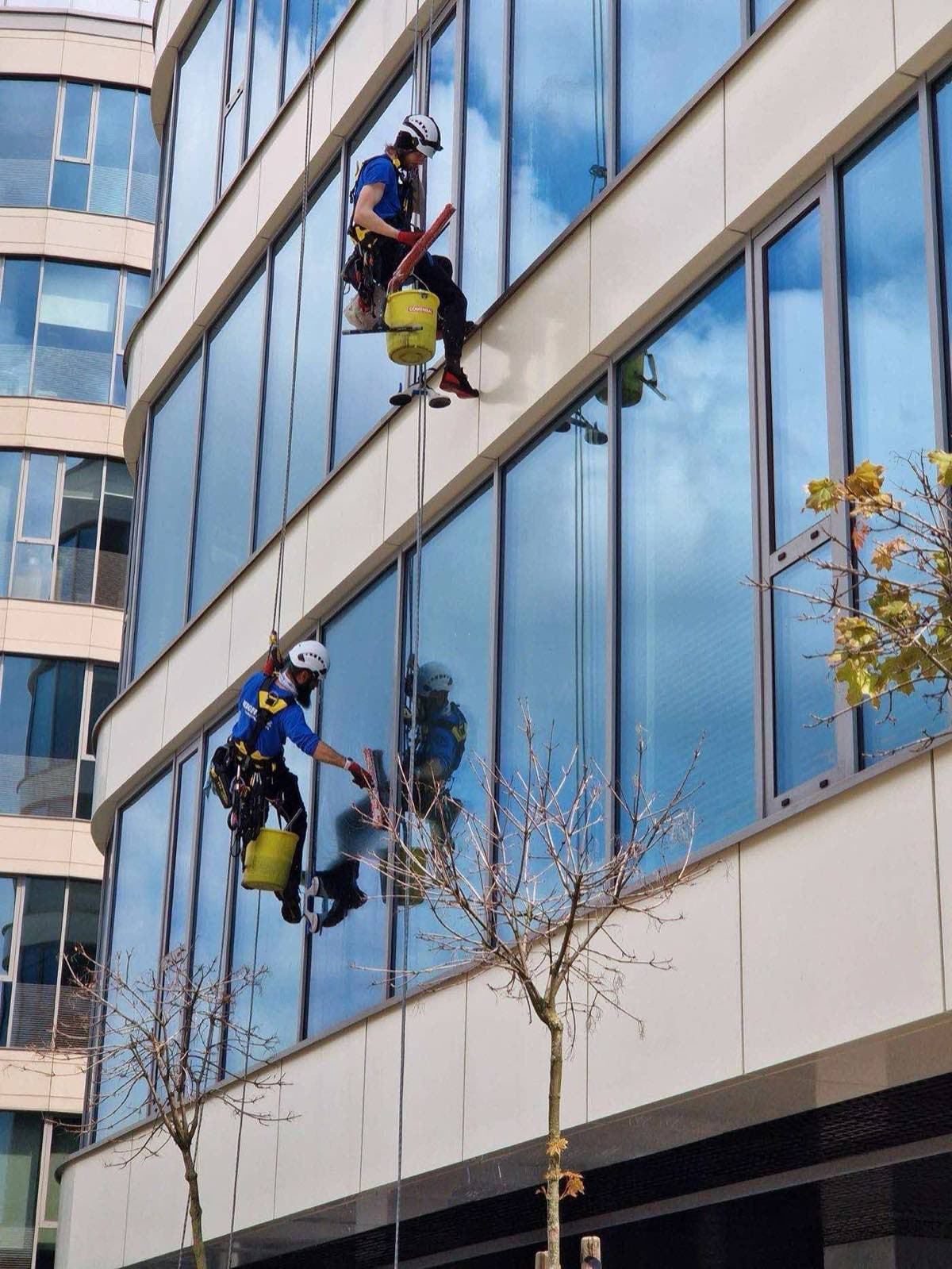
High-access window cleaning
Multi-story and hard-to-reach glass cleaned by crews trained and equipped for elevated work, using rope access or lift equipment as the building requires. This keeps fall-protection exposure with the vendor who is insured for it.
Electrostatic disinfection
Even application of EPA-registered disinfectants across touchpoints and large areas, used for routine programs and for rapid response during an outbreak. Effectiveness depends on observing the product's labeled contact time.
Post-construction cleanup
Rough, final, and touch-up phases that take a newly built or renovated space to occupancy-ready. Construction dust keeps resettling, which is why this is scoped in phases rather than as one clean.
Solar panel cleaning
Scheduled cleaning that restores output lost to soiling and protects equipment warranties, performed with deionized water and non-abrasive methods to avoid damaging panel coatings.
Holiday and seasonal lighting
Design, installation, in-season maintenance, and takedown, with the elevated work and its liability handled by the vendor rather than your staff.
Emergency and turnover cleaning
Rapid response for tenant turnovers, incidents, and unplanned events where the building has to be presentable on a compressed timeline.
How pricing works
What this service typically costs
Specialty work is quoted per project or per event, and periodic programs such as high-access glass are quoted per cycle.
Typical market ranges
- Post-construction cleanup, per square foot
- $0.20 to $0.60
- High-access window cleaning, per cycle
- Quoted per building
- Electrostatic disinfection, per square foot
- $0.05 to $0.20
These are typical published ranges for the US commercial cleaning market, provided as a reference point. They are not a Wexley quote. Specialty work is priced from a site assessment.
What moves the number
- Building height and the access method required, whether lift or rope access
- Amount of glass and its accessibility
- Construction dust load and the number of cleanup phases
- Turnaround window and whether work is after hours
- Disinfectant selection and required contact time
Typical frequency
High-access glass is commonly cleaned two to four times per year. Solar cleaning is typically one to two times per year depending on local dust and pollen. Post-construction and turnover work are one-time by nature.
Answers
Frequently asked questions
How much does commercial cleaning cost per square foot?
Across the US commercial cleaning market, recurring janitorial is typically quoted between $0.05 and $0.25 per square foot per visit, and roughly $0.10 to $0.30 per square foot per month for a standard office cleaned three to five times per week. Hourly rates commonly run $25 to $50 per cleaner per hour. The range is wide because price is driven by frequency, square footage, restroom count, floor type, and how much of the work is detail cleaning versus basic trash and vacuum. Larger buildings almost always cost less per square foot than small ones because fixed travel and setup time is spread across more area. These are industry reference ranges, not a Wexley quote. Accurate pricing requires a walkthrough and a written scope.
What insurance should a commercial cleaning vendor carry?
At minimum, a commercial cleaning vendor should carry commercial general liability, commonly written at $1 million per occurrence and $2 million aggregate, and workers' compensation at statutory limits for the state where the work is performed. Most facility managers also require commercial auto liability if the vendor drives to the site, and a janitorial bond or crime coverage, often $10,000 to $100,000, to cover theft by cleaning staff who hold keys. Larger accounts frequently require an umbrella or excess liability policy. Beyond the policies themselves, the important details are the endorsements: additional insured status naming the property owner and manager, a waiver of subrogation, and primary and non-contributory wording. Without those endorsements, a certificate proves the vendor has insurance but does not extend that protection to you.
What is a COI and why do facility managers require one?
A COI, or certificate of insurance, is a one-page document issued by a vendor's insurance broker that summarizes the policies in force: carrier, policy numbers, coverage types, limits, effective and expiration dates, and any endorsements. It is most often issued on an ACORD form. Facility managers require it because if an uninsured or underinsured vendor's worker is injured on the property, or damages the building, the claim can land on the property owner's policy instead. Requesting a COI that names the owner and manager as additional insured moves that exposure to the vendor's carrier. A COI is a snapshot, not a guarantee, which is why coverage should be re-verified when policies renew rather than filed once and forgotten.
What is green cleaning and does it cost more?
Green cleaning means using products and methods that reduce health and environmental impact, most commonly products certified by Green Seal or EPA Safer Choice, microfiber systems that cut chemical and water use, and equipment with lower particulate emissions. Product cost is generally comparable to conventional chemicals today, so green programs usually price close to standard programs. Where cost does rise is in certification-driven programs, such as cleaning specified to support a LEED operations and maintenance credit, because those require documentation, tracking, and specific product and equipment standards rather than just a product swap.
Related
Where this service fits
Explore the property types this work is scoped for, the markets we operate in, and the rest of the program.
Industries we scope this for
Offices and corporate campuses
Tenant retention starts with a building that always looks maintained, in the common areas and restrooms occupants judge first.Medical and healthcare facilities
Clinics and medical offices answer to higher sanitation and documentation standards. We clean under bloodborne pathogen protocols and log every visit.Retail and shopping centers
Curb appeal drives traffic, and a clean customer experience protects your tenants' sales.Property management portfolios
Managing a portfolio means managing vendor risk at every property. One insured partner, one standard, one invoice.
Available in these markets
Austin, TX
Serving the Greater Austin areaDallas-Fort Worth, TX
Serving the Dallas-Fort Worth MetroplexHouston, TX
Serving the Greater Houston areaSan Antonio, TX
Serving the Greater San Antonio areaSeattle, WA
Serving the Greater Seattle areaTacoma, WA
Serving Tacoma and the South SoundAuburn, WA
Serving Auburn and the Green River ValleySpokane, WA
Serving the Greater Spokane area
Other services
Commercial janitorial
Recurring janitorial scoped to your building, documented and held to a written specification.Floor care
Strip, wax, buff, burnish, and extraction cycles matched to each floor type and traffic load.Grounds and exterior
Curb appeal and exterior safety handled on a schedule, from grounds to parking lots to snow response.Facility maintenance
Light repairs and finish work that close the gap between janitorial and a general contractor.
One accountable partner for your whole facility, fully insured and vetted.
Tell us about your property and we will send a quote within one business day.